Autism and autism spectrum disorder describe the same diagnosis. See what the DSM-5 changed, what Levels 1, 2 and 3 mean, and how support is decided.

Autism and autism spectrum disorder describe the same diagnosis. "Autism spectrum disorder," or ASD, is the clinical term used in the diagnostic manual clinicians work from. "Autism" is the everyday shorthand. If a report says one and a pediatrician says the other, they're describing the same thing.
What changes from one child to the next is the level associated with the diagnosis, and that is where most of the confusion starts. Here is what the terms mean, what Levels 1, 2, and 3 actually describe, and what a level does and does not tell you about your child.
Is there a difference between Autism and Autism Spectrum Disorder?
No. They refer to the same condition.
Before 2013, the diagnostic manual clinicians use, the Diagnostic and Statistical Manual of Mental Disorders, listed several separate diagnoses under an umbrella called Pervasive Developmental Disorders. A child might be diagnosed with Autistic Disorder, or Asperger's Syndrome, or PDD-NOS, depending on which set of criteria they met.
When the DSM-5 was published in 2013, those separate labels were consolidated into one diagnosis: autism spectrum disorder. The current edition, the DSM-5-TR, was published in 2022 and kept that structure.
Today, one diagnosis is described along a spectrum, with a severity level attached. "Autism" and "ASD" are two names for it.
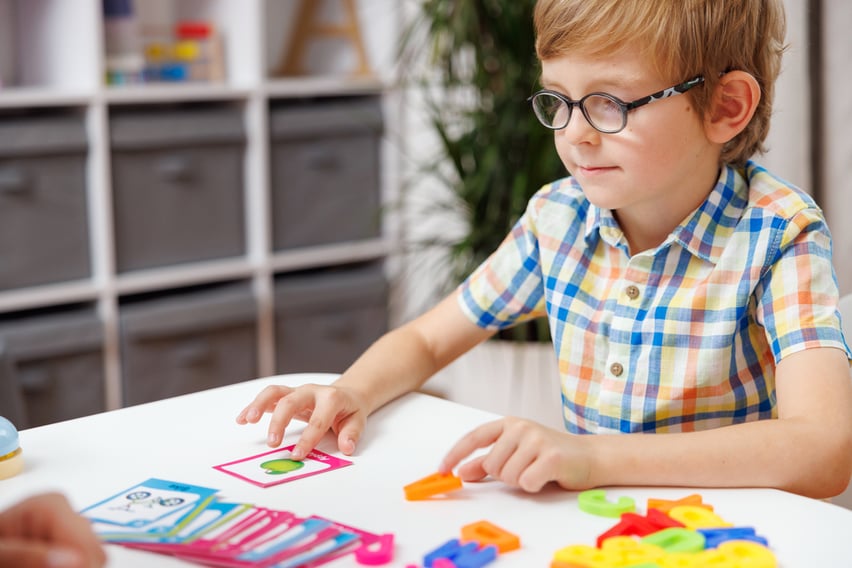
Why Autism is called a "spectrum"
The word "spectrum" is often pictured as a line running from mild at one end to severe at the other, with every autistic person placed somewhere along it. That picture is intuitive, and it is wrong.
Autism affects several distinct areas, for example, social communication, sensory processing, language, flexibility with change, motor skills, and attention, and a person can have significant support needs in one area and very few in another.
A child may speak in full sentences and still find an unexpected schedule change genuinely overwhelming. Others may use few words and navigate social situations with real warmth.
That is what "spectrum" is meant to capture: a profile with peaks and dips. It is also why the diagnostic manual assigns two separate severity levels rather than one. Behaviors like stimming and the sensory differences on an autism behavior checklist show up differently across that profile, which is part of why no two autistic children look alike.
The 3 levels of Autism in the DSM-5-TR
There are three levels of autism. They describe levels of support needed, not levels of severity in the everyday sense, and a clinician assigns them at the time of diagnosis.
Two things about the levels surprise most parents:
- A child receives two levels, not one. One for social communication, one for restricted and repetitive behaviors. A child can be Level 1 in one domain and Level 2 in the other, and many are.
- The level describes support needs. It is a snapshot of what a child needs at the time of assessment, not a prediction of what they will need at ten or twenty.
|
Level |
Social communication |
Behaviors |
Support needed |
|
Level 1 |
Can speak in full sentences but has difficulty starting conversations, reading social cues, or maintaining back-and-forth exchange |
Inflexibility causes noticeable difficulty in at least one setting; switching activities is hard; organization and planning limit independence |
Targeted help with social skills, transitions and executive function; often in a mainstream classroom with accommodations |
|
Level 2 |
Marked difficulty with verbal and non-verbal communication even with supports in place; speech is often simpler and interaction is narrow in focus |
Repetitive behaviors are obvious to a casual observer and interfere across settings; distress or difficulty when routines change |
Consistent daily support across home and school; structured therapy programs; communication supports |
|
Level 3 |
Severe difficulty with verbal and non-verbal communication; may use very few words or none; rarely initiates interaction and responds only to very direct approaches |
Extreme difficulty coping with change; repetitive behaviors markedly interfere with functioning in every area; great distress when routines are interrupted |
Intensive, individualized support throughout the day; communication systems including AAC; close coordination between home, school and therapy team |
Level 1: Requiring Support
Level 1 is the diagnosis a child receives when supports are needed, but daily life is largely navigable with them in place. A Level 1 child often speaks fluently, does well academically, and struggles most during unstructured parts of the day, such as the lunch table, group work, and the walk between classes.
Difficulty here is easy to miss, and often is. Children who mask well can go years without a diagnosis, which is why signs of autism in girls are so often identified late. Deep, focused interests are common at this level and are a strength worth protecting, but there is a real difference between a special interest and an obsession, and conflating the two does children a disservice.
Level 2: Requiring Substantial Support
At Level 2, support is not occasional; it is part of the day's structure. Communication difficulties are apparent even when supports are in place. Speech, when present, tends to be simpler and to center on a narrower set of topics. Changes to routine are not a preference but a genuine source of distress.
Children at this level typically do best with a consistent program across all environments, so that the same expectations, prompts, and reinforcement follow them from the therapy room to the classroom to the kitchen table.
Level 3: Requiring Very Substantial Support
Level 3 describes the most substantial support needs. Verbal communication may be very limited or absent, and non-speaking autism is common at this level, though it is important to say clearly that non-speaking does not mean non-communicating and does not indicate anything about intelligence.
Many children at Level 3 communicate effectively through augmentative and alternative communication (AAC) devices, picture systems or signs.
Support at this level is intensive and individualized and typically involves close coordination among the family, school, and clinical team.
Can a child's level change over time?
Yes. Levels are reassessed, and they move most often as a child gains skills and needs less support, though a level can also be revised upward if demands increase faster than skills do, which is why some children are re-leveled during the transition to middle school.
The diagnosis itself does not go away. Autism is lifelong. What changes is how much scaffolding a person needs to do what they want to do, and that is exactly what a level is measuring.
What Happened to the other "types of autism"?
Search for "types of autism" and you will still find pages listing five separate conditions. Those lists describe the DSM-IV, which was replaced more than a decade ago. Here is what became of each.
Asperger's Syndrome
Asperger's was removed as a standalone diagnosis in the DSM-5 in 2013. People who would previously have met its criteria are now diagnosed with autism spectrum disorder, most often at Level 1.
The term has not disappeared. Many adults diagnosed before 2013 still identify with it, and that is entirely legitimate, since it is a diagnosis given under an earlier manual that does not expire. But a child assessed today will not receive an Asperger's diagnosis, and clinicians increasingly avoid the term for reasons connected to Hans Asperger's documented conduct during the Nazi era.
Pervasive Developmental Disorder Not Otherwise Specified (PDD-NOS)
PDD-NOS was the DSM-IV's category for children who showed clear autism traits but did not meet the full criteria for Autistic Disorder. It functioned as a catch-all, and its boundaries were never crisp. It was folded into ASD in 2013, where the severity levels do the work the separate label used to do, with considerably more precision.
Autistic Disorder ("Classic Autism")
What was once called classic autism, or Kanner's autism, described children with significant differences in social interaction, communication, and behavior appearing in early childhood. It is now simply autism spectrum disorder, usually with a Level 2 or Level 3 designation.
Childhood Disintegrative Disorder
Childhood disintegrative disorder described a rare pattern in which a child develops typically for the first several years and then loses language, motor, and social skills over a short period. The DSM-5 removed it as a separate diagnosis. Now, children showing this pattern are diagnosed with ASD, with the regression noted in the clinical record.
Rett Syndrome
Rett syndrome is a rare genetic disorder caused in most cases by a mutation in the MECP2 gene, and it occurs almost exclusively in girls. It was removed from the autism category in the DSM-5 because it has an identified genetic cause and a distinct course, including physical impairments not seen in autism.
A person with Rett syndrome can also be diagnosed with ASD if they meet the criteria, but the two are separate conditions.

How Autism Spectrum Disorder is diagnosed
There is no blood test or brain scan for autism. Diagnosis rests on two things: a detailed developmental history from the people who know the child best, and direct observation of the child by a trained clinician.
A diagnostic evaluation is usually carried out by a developmental-behavioral pediatrician, a child psychologist, a child psychiatrist, or a neurologist, and typically involves:
- A structured developmental and medical history taken from parents or caregivers
- Standardized observation and interview instruments
- Input from teachers or daycare staff about how the child functions outside home
- Screening for co-occurring conditions, such as ADHD, anxiety, language disorder, sleep and feeding difficulties
Autism can be reliably diagnosed from around age two, and screening at 18 and 24 months is part of routine well-child care. It can also be diagnosed at any age, and a growing number of people are identified in adolescence or adulthood.
Does Autism Run in Families?
Yes, to a meaningful degree. Autism is among the most heritable of developmental conditions, though heritability is not the same as a single inherited gene. Hundreds of genetic variants have been associated with autism, most contributing a small amount of risk, and many arise spontaneously rather than being passed down.
The clearest figure available comes from the Baby Siblings Research Consortium, whose 2024 study in Pediatrics followed more than 1,600 infants who had an older autistic sibling. It found a familial recurrence rate of 20.2%. Roughly one in five younger siblings was also diagnosed with autism, up from the 18.7% reported by the same group in 2011.
For context, the Centers for Disease Control and Prevention's most recent surveillance found that about 1 in 31 eight-year-olds in the United States has been identified with autism spectrum disorder, and that it is diagnosed over three times as often in boys as in girls, a gap researchers increasingly attribute in part to under-recognition in girls rather than to true prevalence.
If you have one autistic child, it is worth watching a younger sibling's development attentively and raising anything you notice with your pediatrician early rather than waiting. It does not mean a second diagnosis is likely, since four in five younger siblings are not diagnosed.
What a level actually means for therapy and support
Here is the part that matters most, and the part the levels are worst at communicating: a level is a starting point for planning, not a prescription.
Two children given the same Level 2 designation can need very different programs. One may need most of the work directed at communication, but the other may communicate well and need help tolerating change. The level tells a team roughly how much support to plan for. What that support consists of comes from assessment of the individual child.
In practice, a level influences three things: how many hours of therapy are recommended, which setting is the best fit, and what insurers will authorize. ABA therapy is the most widely researched intervention for autism, and at Circle Care it is delivered in a neurodiversity-affirming way.
Depending on a child's age, level, and family circumstances, that can look like:
- Center-based ABA: structured sessions with ABA, speech and occupational therapy on site, plus small-group work for school readiness (ages 2–5)
- In-home ABA therapy: skills taught in the environment where they actually need to be used (ages 2–12)
- ABA in a daycare setting: support delivered alongside typically developing peers
- ABA+ wraparound support: IEP advocacy, a parent hotline, referrals, and sensory-friendly community events
If you are weighing this up, our guide to the ABA intake process walks through what the first few weeks look like, and you can check whether your insurance covers ABA before you commit to anything.
Where to go from here
If you have just been handed a report with a level on it, the most useful thing to know is that the level describes support, written on a particular day by someone who met your child once or twice. It is genuinely useful for planning.
What tends to help most in the first weeks is not more research, but one conversation with someone who does this every day and can tell you the next concrete step. We also cover what to do in the days after a diagnosis, and if you would rather talk to someone, we are here.
Sources:
- Centers for Disease Control and Prevention: Autism Data and Statistics (ADDM Network, 2022 surveillance year).https://www.cdc.gov/autism/data-research/index.html
- Centers for Disease Control and Prevention: Diagnosis of Autism Spectrum Disorder (DSM-5-TR criteria and support levels).https://www.cdc.gov/autism/hcp/diagnosis/index.html
- National Institute of Mental Health: Autism Spectrum Disorder.https://www.nimh.nih.gov/health/topics/autism-spectrum-disorders-asd
- Hansen et al., "Familial Recurrence of Autism: Updates From the Baby Siblings Research Consortium," Pediatrics, 2024.https://publications.aap.org/pediatrics/article/154/2/e2023065297/197777/Familial-Recurrence-of-Autism-Updates-From-the
- Children's Hospital of Philadelphia, Center for Autism Research — Diagnostic Criteria for Autism Spectrum Disorder in the DSM-5.https://research.chop.edu/car-autism-roadmap/diagnostic-criteria-for-autism-spectrum-disorder-in-the-dsm-5
- Autism Speaks: Levels of Autism.https://www.autismspeaks.org/levels-of-autism

HELP FOR THE HARD PART OF THE DAY.
When the next tantrum hits... do you feel prepared, or do you feel stuck trying to figure out what to do? Get weekly emails from clinicians and parenting experts who know what to do when autism meets real life!

GOT A QUESTION?
You don’t have to be “ready” for anything to get help from our team. If you have a question about your child, ABA, screening, or anything about autism… give us a call anytime.