A sensory room gives an autistic child a space to regulate. See what goes in one, what the research shows, how to build one at home, and how to use it well.

A sensory room is a space where you intentionally turn sensory input up or down so a child's nervous system can return to a state where they can think, play, and learn.
Here is what a sensory room is for, what the research actually shows, what goes in one and why, how to build a workable version at home for very little money, and how to tell whether it is helping your child.
What is a sensory room?
A sensory room is a dedicated, controlled space where sensory input can be adjusted to suit the person using it: dimmed or brightened, quieted or added to, still or moving.
You will see the same idea under a lot of names, and they are mostly the same thing at different scales:
- Sensory room or sensory space: a whole room dedicated to it.
- Sensory corner, sensory zone, or calm-down corner: a defined area inside a room the family already uses. Most homes are built this way, and it works.
- Multi-sensory environment (MSE) or Snoezelen room: the clinical term, usually for a purpose-built room with bubble tubes, fiber-optic strands, and projection, found in schools, hospitals, and therapy centers.
- Sensory gym: movement-led with swings, climbing, crash pads, ball pits, etc. A different job, covered further down.
In a sensory room, the child should be able to change how the space affects them.
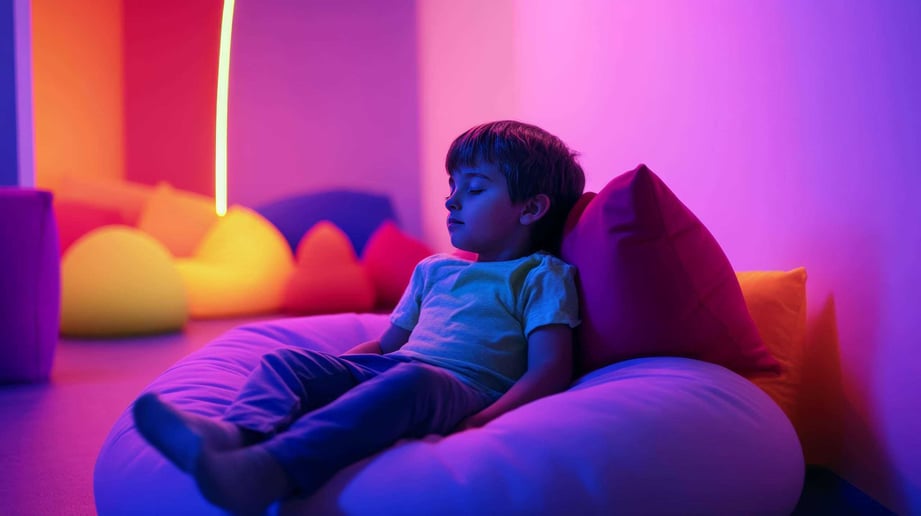
What a sensory room is actually for
A sensory room has two jobs, not one, and they pull in opposite directions.
- Calming (down-regulating): For a child who is overwhelmed, with too much noise, too much light, or too many people, the room reduces input. Dim, quiet, enclosed, predictable.
- Alerting (up-regulating): For a child who is under-responsive or sensory-seeking, the room does the opposite: it delivers strong, organized input, so the child can get the input they are looking for in a safe, contained way instead of by climbing on the furniture.
The diagnostic criteria name both directions in the same line: “hyper- or hyporeactivity to sensory input or unusual interest in sensory aspects of the environment.” Most autistic children show a mix, and the mix changes by system and by day. The same child can be sound-avoidant and movement-seeking at once.
So the first question is not “what should I buy.” It is which direction my child needs to go, and in which sensory system. Build a dim, quiet retreat for a child who is seeking movement and pressure, and it will sit unused, through no fault of yours. Nobody hands you a manual for this.
What goes in a sensory room?
Organize the space by the system you are targeting rather than by product category. Most rooms only need two or three of these:
|
Sensory system |
Goal |
Examples |
Signs your child may need it |
|
Proprioceptive |
Calms an overwhelmed child and satisfies a seeking one |
Crash pad, body sock, weighted lap pad, resistance bands on chair legs, pushing or carrying heavy things, therapy putty |
Crashes into furniture and people, bear hugs, chews, stomps, likes tight clothes or being squashed |
|
Vestibular |
Alerting when fast and irregular, calming when slow and rhythmic |
Platform or hammock swing, rocking chair, balance board, spinning seat, mini trampoline |
Spins, rocks, hangs upside down, is constantly in motion, or the opposite when avoids playgrounds and movement |
|
Tactile |
Gives the hands and body something regulating to do |
Sensory bins (rice, beans, water beads), textured wall panels, fidgets, fabrics of different weights |
Touches everything, or refuses textures, tags, certain foods, and messy play |
|
Visual |
Usually about reducing input, sometimes about giving the eyes one predictable thing to track |
Dimmer switch, blackout blind, bubble tube, fiber-optic strands, projector, liquid floor tiles and uncluttered walls |
Squints, covers eyes, is bothered by fluorescent light or stares at spinning and sparkling things |
|
Auditory |
Almost always about reducing and controlling sound |
Noise-canceling headphones, soft furnishings, a rug, white-noise machine, a speaker the child controls |
Covers ears, distressed by hand dryers, vacuums, assemblies, or hums, and vocalizes to make their own sound |
|
Oral and olfactory |
Calming input through the mouth, since scent is highly individual and easy to overdo |
Chewelry, crunchy or chewy snacks, a straw and water bottle |
Chews clothing or objects, mouths things, or gags at smells others do not notice |
A few things belong in every version of the room regardless of profile: an enclosed retreat (a pop-up sensory tent, a canopy, a cleared closet, a cardboard box that a child chose), soft flooring, and a way out that is always available.
If you are choosing items, our roundups of toys that help sensory regulation and comfort items for autism go into specifics.
How to set up a sensory room at home
Start with your child
Spend a week noticing your kid. When does your child get dysregulated, and what is happening around them? What do they already go to: the trampoline, the beanbag, the dark space under the table, the sink? Those are the answers you need.
In therapy, this is formalized as a preference assessment: you present options and record what the child actually chooses, repeatedly, rather than what an adult assumes they will like. Do the same at home.
Pick the space
A whole room is a luxury, and it is not the goal. A corner of a bedroom with a canopy over it, a landing, a walk-in closet, or a pop-up tent in the living room all work, and the smaller versions have a real advantage, because they sit inside the environment the child actually lives in, so the regulation happens where it is needed.
Choose a spot the child can reach without asking permission, away from the heaviest traffic in the house, with a door or opening the child can use in both directions.
How a sensory room fits into therapy
Used well, the space scaffolds the actual work.
- Sensory breaks: A short, planned visit to the space built into the day, for example, before a demanding activity, between tasks, or after school. Don't use it only as a rescue once a child is already past the point of coping.
- As part of a routine: In ABA therapy, skills are taught where they are needed, and it is the principle behind natural environment teaching. The same logic applies here. In other words, the goal over time is for the child to learn to notice they need a break and ask for one, wherever they are.
- Teaching the request: For many children, the most valuable outcome of having the space is not the space; it is that “I need a break” becomes a thing they can communicate, by speech, sign, card, or device, instead of by escalating.
However, ABA is not sensory integration therapy, and the two should not be confused. Circle Care's center programs run ABA, speech, and occupational therapy on the same site, and sensory questions belong with the OT.
ABA contributes teaching and coaching to help you run it at home. Our in-home program works in the corner you’ve already built, with your furniture and your evenings. You don’t have to become an OT, a BCBA, and a project manager on top of being a parent. That part’s our job (Yours is the harder one.)
Sensory room vs. sensory gym vs. calm-down corner
These three get used interchangeably, and they are not the same thing. They do different jobs, cost very different amounts, and only one of them is a sensible first project for a family at home.
Sensory room
A sensory room (or sensory space) is the adjustable option. Its defining feature is that you can turn input on or off, as we saw in this article, which suits a child whose needs vary by day, by system, or by time of day.
A full version usually has lighting control, a tactile element, a visual element such as a bubble tube or fiber-optic strands, an enclosed retreat, and soft flooring. The clinical build, sometimes called a multisensory environment or a Snoezelen room, is found in schools, hospitals, therapy centers, and a growing number of airports and stadiums.
It is also the one space that needs a dedicated room to do it properly. Worth building at home only if you have the space and a clear picture of your child's sensory profile.
Sensory gym
A sensory gym is purely movement-led. It exists to deliver proprioceptive and vestibular input, which is organizing rather than soothing, and it is what a sensory-seeking child is usually looking for.
It holds platform and hammock swings, climbing structures, crash pads, a ball pit, scooter boards, and a trampoline. All of that needs ceiling height, joist-mounted anchors, and proper matting, which is why a genuine sensory gym is rarely feasible at home and why families are usually better off using one that already exists.
Circle Care's ABA centers have a sensory gym and a motor room on-site, alongside the therapy rooms. In other words, the expensive, hard-to-install equipment lives at the center, and the simple, high-value version lives at home.
Calm-down corner
A calm-down corner (also called a sensory corner, sensory zone, or calming room) is a reliable, low-stimulation retreat. It does one thing only, and it does it in a corner of a room the family already uses.
Cushions or a beanbag, a canopy or pop-up tent, noise-canceling headphones, a dimmable light, and one or two familiar comfort items are the whole build. It costs very little and fits anywhere, including a classroom. If you build only one of these three, build this one.
Where to find public sensory rooms?
Sensory rooms are appearing in places families actually have to go. A growing number of US airports have them past security, and stadiums, arenas, museums and some theme parks now run quiet rooms or sensory-friendly sessions.
They vary enormously, so it is worth checking before you travel. Two things to look for: whether the space is staffed, and whether it is inside the secure area or before it.
Circle Care runs a sensory-friendly certification program that works with local businesses and venues on the training, the accommodations, and the physical space, and we cover sensory-friendly movie showings separately, since those are usually the easiest first outing for a family testing the waters.
How to tell if the sensory space is working
You don't need a data sheet, but you do need more than an impression. Pick two or three things and watch your child for a fortnight:
- Time to settle: Roughly how long from entering the space to being calm? A shorter time over time is the signal you want.
- What happens next: Does your child return to what they were doing, or does the day stay derailed? Returning to activity is the outcome that actually matters.
- Do they ask for it? A child who starts requesting the space, in any form, has learned something genuinely useful.
- Frequency of escalation: Fewer or shorter meltdowns across a week, not on any one day.
Signs it isn’t working: your child avoids the space, gets more wound up in it rather than less, only ever goes when sent, or nothing about the rest of the day changes. If that’s what you’re seeing, the profile was probably read in the wrong direction. That’s information, not a failure, and it’s the kind of thing we read for a living.
You shouldn’t have to read your child like a research paper on your own, at night, after the day you’ve just had. Our occupational therapists read sensory profiles for a living, our BCBAs build the break-and-request routine around what they find, and we train you to run it in the corner you’ve already set up.
That’s 360° of support around the whole family, not a worksheet we hand you at the door.
Frequently Asked Questions
Do sensory rooms actually work?
The evidence is limited but not empty. A 2025 systematic review in Autism found only 10 studies of multisensory environments for autistic people, with small samples; four reported reductions in stereotyped behavior, with some signal on attention and anxiety, and the authors concluded the overall evidence is insufficient.
The most consistent finding was that participants who controlled the equipment themselves did better than those passively exposed to it.
How do I make a sensory room at home on a budget?
You can build a workable version for well under $150. Use what you have, such as pillows and duvets for a crash pile, a laundry basket of dried rice or beans, a dimmable lamp, a sheet over a table as the retreat. Then buy in this order: children's noise-canceling headphones, a pop-up sensory tent or canopy, a foam mat, and a weighted lap pad or body sock.
What is a Snoezelen Room?
Snoezelen is the original brand name for a purpose-built multi-sensory environment, typically with bubble tubes, fiber-optic strands, projection, and music, used in schools, hospitals, and care settings.
Evidence for these rooms is limited, and reviews consistently note that what happens during a session is often poorly defined.
How long should a child spend in a sensory room?
Short, planned sessions work better than long, reactive ones. Many programs use built-in breaks of around 5 to 15 minutes each day, with the child able to leave sooner. Movement equipment in particular should start with very short bouts, because effects can be delayed by hours. Watch your own child rather: the goal is to return to activity, not to stay in the room.
Is a sensory room the same as a time-out space?
No, and treating it as one will stop it from working. A sensory room is somewhere a child chooses to go to regulate, with the exit always available. A time-out is a consequence given to a child in response to behavior. If the space becomes where you send your child when adults are unhappy, it loses its function, and access should never be contingent on behavior.
Does insurance cover a sensory room?
Insurance does not generally pay for home sensory equipment. What is covered, where a plan's autism benefit applies, is the therapy itself (ABA, occupational therapy, and speech therapy), which may be delivered in a center that has a sensory gym and sensory spaces on site.

HELP FOR THE HARD PART OF THE DAY.
When the next tantrum hits... do you feel prepared, or do you feel stuck trying to figure out what to do? Get weekly emails from clinicians and parenting experts who know what to do when autism meets real life!

GOT A QUESTION?
You don’t have to be “ready” for anything to get help from our team. If you have a question about your child, ABA, screening, or anything about autism… give us a call anytime.