Summer learning loss can be prevented. Help protect your child’s hard-earned skills and create a supportive summer—especially for autism.

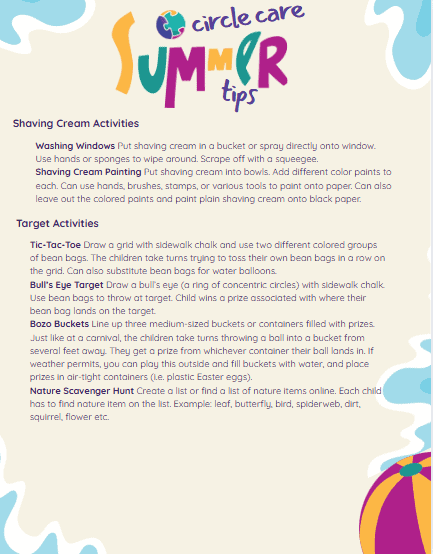
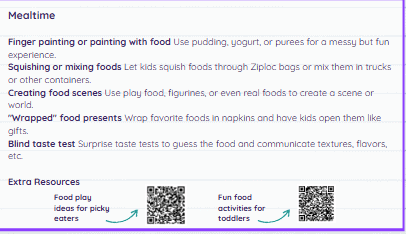
Summer DIY Activity list included below!
Skill acquisition is like walking up a downward escalator. An ordinary staircase doesn’t go anywhere unless you do – and if you just stand still, you stay in the same place. But an escalator moves you, and if you stand still on it you’re brought down to a lower level.
Our children learn and build new skills throughout the school year. Since these skills are still new and fresh, we need to actively help our children maintain them. They’re on the downward escalator, and if they don’t run upwards by practicing their new skills, they will regress.
Summer learning loss is real. In the summer, our children don’t have the structure of a school setting. Without that consistency, they might lose some of their fresh skills if they don’t actively maintain them.
Summer regression and autism
While most children slide back over summer vacation, the summer slide can be even steeper for a child with autism. “Students with severe autism often learn at very slow rates, and when this learning is disrupted, it slows it down even more,” says Jana J. Duncan, in her study The Impact of Summer Break From School on Children With Severe Autism and Their Parents (2016).
As parents, maintaining skills over the summer is up to us: we give our children the support to climb up that downward escalator. For a child with autism, that summer learning loss prevention is that much more important.
But we parents are always busy. We have a lot going on, from therapies to academic support to medical needs. And for a child with autism, we often invest that much more time and effort into helping them build their skills. How can we take on more?
Skill retention doesn't have to be overwhelming, and it doesn't have to be an official learning program. There are ways to combat summer behavior regression that will help your child develop and retain real skills, and won’t take over your life.
1 practical idea: don’t try to work on everything. Pick the 2 or 3 most important skills to practice over the summer. (Tip: if you aren’t sure what to focus on, reach out to your child’s teacher or school support team.) Practicing doesn’t have to be complicated. You can have your child work on their skills by completing tasks that you might do every day. Ask your child's teacher, BCBA, and/or therapists for practical and easy ways you can maintain the skills through everyday activities. You don't want to become your child's "teacher" when you practice with them, so keep it light and make it a playful learning experience.
Engaging activities that maintain skills
A lot of educational activities are also fun. There’s math and reading that comes up often in things you already do – or that you can add into regular summer activities. Numbers come up every day. So do words and language. Bring them up whenever you can and have your child practice their skills in low-pressure ways.
- If you’re in the car, play the ABC game. It’s a race to find the alphabet, in order, on signs you pass as you drive.
- Bake with your child. Ask them to find numbers on the recipe, to read out the steps (if they know how to read), or measure the ingredients.
- Do arts and crafts together. Creating patterns, reading instructions, counting pieces — there are so many ways crafting is good for your child.
- Build models together. That will help your child’s logic skills, reading skills if they read the directions, and their fine motor skills too.
- Find educational video games like Reader Rabbit, the Magic School Bus, or ABC Mouse. (I don’t recommend a lot of screen time. Your child should play outside and interact with the world more than they’re on their screen.)
- Read to your child every day and encourage them to look at books on their own, even if they can’t read yet. When they look over your shoulder while you read a book, go through the mail, or visit a website, ask them which letters or words they recognize.
- Visit museums. It builds your child’s knowledge base, piques their interest, and can help them see math and science at work. Museums also make a great day trip that can fill up those endless summer afternoons.
Get hands on whenever you can. Children learn best when we engage them and let them do things themselves. It might be messy, but I always find that it’s worth it. Besides building skills, you get to bond over doing things together.
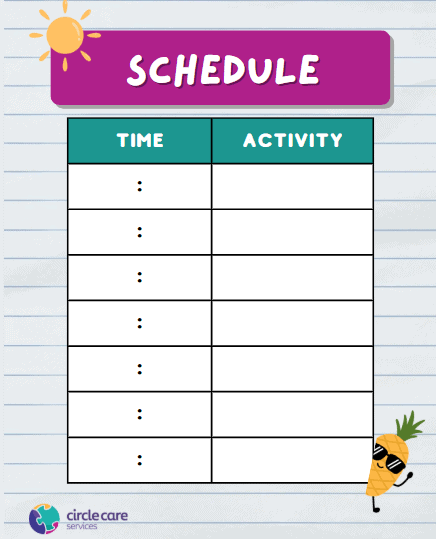
Besides doing extra activities, it’s important to establish a summer routine. When there’s a set daily schedule, it is easier to incorporate skill-building activities and to maintain your child’s levels of skill over the extended break.
Download more of our summer activities here.
Therapy and continued support at home
If your child receives ABA therapy, their therapist may be able to offer them additional hours of support over the summer. Since school is out, this is a great way to add structure to their day and to prevent skill regression. Therapy can also be an enjoyable summer program, since your child will make meaningful progress with more focus on their therapy and a play-based learning approach.
It’s important for you to support your child’s progress, too. Ask your child’s therapists about their therapy goals and how you can incorporate them into your routine. As the one who spends the most time with your child, your support and guidance toward their learning targets makes the biggest difference to their progress.
Download our visual summer schedule

Extended School Year programs
Some children can get Extended School Year Services (ESY) if they are in a special education program. ESY extends the school year past the standard 180 days. If your child qualifies for ESY, they can receive educational support over vacation to prevent summer learning loss.
If your child will be set back significantly if they don’t continue their learning, they might be able to get summer learning support. They might also qualify if they’re close to reaching a long-worked-for breakthrough or they aren’t making progress on a specific IEP goal.
If your child’s IEP team determines that they are eligible for ESY, your school district provides it at no additional cost.
When summer learning loss isn’t a problem
We always want our children to build new skills and make progress. But it’s important to keep in mind that some regression is normal over the summer. Don’t get nervous if your child doesn’t read as well or takes an extra few seconds to remember something they knew (as long as it isn’t extreme). Your goal with summer skill retention is to help them hold onto skills enough that they can bounce right back when school starts again.
If your child seems to lose their proficiency to an extreme level, reach out to their school to discuss it. Otherwise, don’t stress over it. Just make practice fun for them so they don’t even realize they are working on their skills.
Remember that downward escalator? If you run up an escalator, you might get to the top. If you climb quickly, you’ll stay at the same level. If you climb slowly, you’ll go down just a little bit. But if you stand and do nothing, you'll definitely end up at the bottom. Even if you can’t do a lot of practice, don’t give up on maintaining skills over the summer. Whatever practice you can do will at least minimize the loss over the summer.
Summer is a time for fun and games, but that doesn’t mean there’s no time for learning. And learning doesn't need to be boring or tedious – it can be part of the summer fun. This summer, take the time to secure your child’s skills and give them a gift that will serve them well next school year – and for life.
Frequently Asked Questions
What is summer learning loss?
Summer learning loss is the decline in academic and developmental skills that can happen when children are away from the structure of school during summer break. This can affect reading, math, and behavior skills, especially for children with autism.
Why is summer learning loss more severe for children with autism?
Children with autism may rely more heavily on routines, structure, and consistent support. Without these in place, they are more likely to regress in communication, social, or behavioral skills over summer break.
How can I prevent summer learning loss in my child with autism?
You can prevent summer learning loss by keeping a routine, focusing on 2–3 key skills, incorporating learning into daily activities, and continuing therapy or support services when possible.
Do I need a formal program to help my child over the summer?
No. Practicing simple skills through everyday routines—like baking, reading, or playing games—can be just as effective. The key is consistency, not formality.
What is Extended School Year (ESY) and how can it help?
Extended School Year (ESY) services provide continued special education support beyond the typical school year. If your child qualifies, ESY can help maintain progress and prevent regression during summer break.
What if my child still regresses over the summer?
Some regression is normal. The goal is to minimize it so your child can bounce back quickly when school resumes. If the loss is severe, contact your child's school or therapy team for guidance.
Can ABA therapy help with summer structure?
Yes. ABA therapy can offer consistent routines, targeted skill practice, and engaging sessions that support your child’s development throughout the summer months.
How do I balance learning with fun during summer break?
Make learning part of the fun—use games, outings, and crafts to reinforce skills naturally. When practice is playful and low-pressure, children stay engaged and enjoy the process.

HELP FOR THE HARD PART OF THE DAY.
When the next tantrum hits... do you feel prepared, or do you feel stuck trying to figure out what to do? Get weekly emails from clinicians and parenting experts who know what to do when autism meets real life!

GOT A QUESTION?
You don’t have to be “ready” for anything to get help from our team. If you have a question about your child, ABA, screening, or anything about autism… give us a call anytime.